
*
*
An historic literary collection of letters by women writers, early plays and a first edition of Sanditon finds a permanent Home at Chawton House, thanks to a generous donation from JASNA ORSWWA.
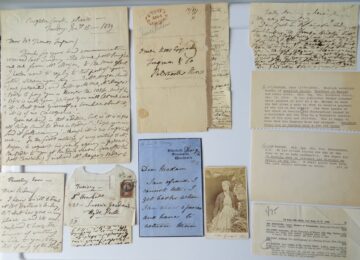
Chawton House has received a major donation that includes three handwritten letters by the important novelist Jane Porter (1775-1850), several popular 18th-century plays, a first edition of Sanditon, and materials from other 19th-century women writers. The donation comes from the Oregon-SW Washington (ORSWWA) region of the Jane Austen Society of North America (JASNA).
“We were delighted to receive the Porter letters and other documents,” said Vonnie Alto, ORSWWA’s regional coordinator, “but we did not have any way to preserve or display the fragile items. We chose Chawton House as their permanent home because of its focus on Jane Austen and early women writers and its existing collection of Porter letters.” The donation was facilitated by the North American Friends of Chawton House.
ORSWWA came into possession of the materials from Linda Hardie of Portland. The collection includes items related to Victorian author Augusta Mary Ward (known professionally as Mrs. Humphry Ward, 1851-1920) and C. M. Yonge (1823-1901), a Victorian era Hampshire writer. Hardie had received them from a longtime Janeite, Susan McGlennan Schwartz, who died after a long illness in November 2025. Susan was a bookstore owner and collector with an interest in women’s writing, and also a JASNA member for over 40 years, serving on both regional and national boards.
Included in the trove are:
Three Jane Porter letters
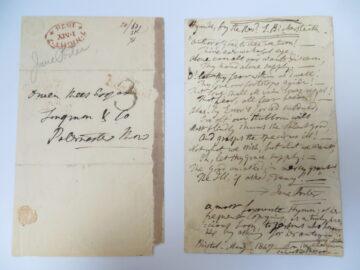 A three-page letter from 1827 that includes a single-page insert; an 1828 letter to her publisher that contains a copied-out hymn; and an 1839 letter to her publishers regarding a payment and expressing concern over severe weather.
Jane Porter (and her sister Anna Maria Porter) pioneered historical fiction in English. Their lives and literature are documented in Devoney Looser’s Sister Novelists: The Trailblazing Porter Sisters, Who Paved the Way for Austen and the Brontës (2022).
–
First edition of A Fragment of a Novel (Oxford Clarendon’s 1925 edition of Sanditon)
The book, a review copy, is inscribed by editor R. W. Chapman to a well-known British essayist and politician, Augustine Birrell, who wrote a review of the novel fragment that is attached within the cover.
–
Three plays that Jane Austen knew
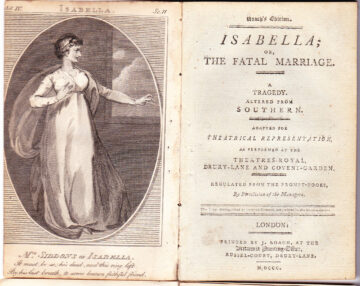 A 1775 copy of the play Matilda, which according to historian Sue Wilkes was the first play performed by the family at Austen’s family home at Steventon in 1782; an 1826 copy of the play High Life Below Stairs, which was performed at the Steventon rectory in 1788-9; and an 1800 copy of the play Isabella, which originally starred Sarah Siddons. This was the final play that we know Jane Austen saw at Covent Garden in 1814, although she saw Eliza O’Neill in the leading role. These plays will be added to our current display on women on the stage at Chawton House.
–
Mary Augusta Ward documents and letters
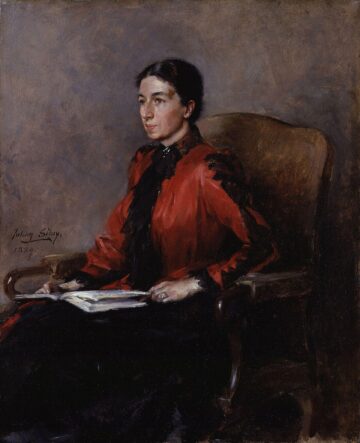 Several contracts and copyright documents, along with letters related to the US publication of novels by Victorian novelist Mary Augusta Ward and her daughter, Dorothy.
Mary Augusta Ward was a social campaigner with a complicated legacy. Whilst she supported the opening of Oxford University to female students, and was instrumental in the establishment of Somerville College, she also became the founding President of the Women’s National Anti-Suffrage League, and was deeply critical of the Suffragettes. Despite living in England, her novels (of which she wrote at least 25) became very popular in America.
The Porter and Ward materials were found interspersed, leading to speculation that perhaps Ward collected the Porter letters. Autograph and letter collecting was a popular pursuit in the 19th century, also evidenced in the Strutt letters, which we acquired last year, which contained letters by Jane Porter, amongst other women writers: Amelia Opie, Felicia Hemans and Maria Edgeworth.
–
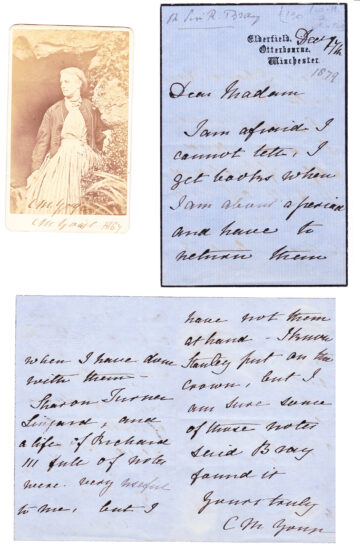
Charlottte Yonge letter and rare photograph
Prolific novelist Charlotte Yonge wrote around 160 novels in her life, and lived in Otterbourne, Hampshire. Today, a statue of her sits on a bench outside Eastleigh station. Her most famous novel is The Heir of Redclyffe (1853), which was immensely popular when published – Louisa May Alcott and William Morris were among its admirers.
*
Deputy Director Kim Simpson said, “We are absolutely delighted to receive this generous donation, which strengthens Chawton House’s nationally significant collection of pre-20th-century women’s writing. The Porter letters are a particularly exciting addition, complementing the Porter correspondence already held in our collections and helping us build an even richer archive of manuscript material by women writers. Alongside the letters, the theatrical works, Sanditon first edition, and other manuscripts open up exciting opportunities for interpretation and research.”
We look forward to incorporating these acquisitions into future displays, including a planned exhibition celebrating Hampshire women writers and an enhancement of our current display on women and the stage in the Servants’ Passage. As with all of our collections, these materials will also be made available to researchers, ensuring they continue to inspire new scholarship and deepen our understanding of women’s literary history.
We are hugely grateful to all the members of JASNA Oregon-SW Washington, and to our North American Friends for bringing this fascinating collection to Chawton.