
Many of our supporters will know that this year is the bicentenary of the publication of Jane Austen’s novel Emma.
It was published by John Murray II on 23 December 1815, with 1816 on the title page. In March we will be launching an exhibition to commemorate this landmark in Jane Austen’s publishing career. Items from our own collection, and the Knight family collection (belonging to Austen’s brother, and on deposit here) will be used to talk about the world of the novel and its reception through the nineteenth, twentieth and twenty-first centuries. And some unique manuscript material will be joining selected work from our own collection. This is the first time we have been able to solicit loans from other research libraries, and it’s all thanks to the generosity of individuals, and the Garfield Weston Foundation, who have provided us with funding to equip our Exhibition Room with state-of-the-art display cases.
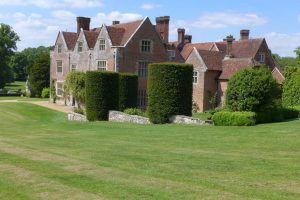
It has been suggested that Donwell Abbey in Emma was modelled on Chawton House.
There is no more fitting setting. Jane Austen’s Emma is the only one of her novels to focus exclusively on ‘three or four families in a country village’. This is the scope Jane Austen recommended to her niece Anna, herself a budding author. And certainly, there’s something very pleasing about planning the exhibition in the village of Chawton, surrounded by ‘English verdure’. Although the fictional village of Highbury is in Surrey, not Hampshire, some have claimed nearby Alton is the model for it. It has also been suggested, over the years, that Donwell Abbey was modelled on Chawton House. And the names Knight and Knightley are tantalisingly suggestive.

Margaret Cavendish, Duchess of Newcastle (c.1623-73) was the first person to publish a critical essay on Shakespeare. Austen is one of many women writers who made reference to Shakespeare.
Our largest exhibition area is our new Exhibition Room. Here, we shall be highlighting Austen’s move to John Murray II by displaying works by other women writers published by the house of Murray in the 1800-1820 period. We have first editions of many such publications, from Stéphanie-Félicité de Genlis’s The Duchess of La Valliere (1804) to Susan Ferrier’s Marriage (1818), and non-fiction by writers from Maria Rundell to Germaine de Staël. Jane Austen famously said of John Murray II that he was “A Rogue of course, but a civil one”. Murray’s correspondence with Austen’s contemporaries Maria Graham, Felicia Hemans and Helen Maria Williams gives a more nuanced picture of this leading light of Regency-Period publishing.
The exhibition is included in the price of admission and will run from 21 March to 25 September 2016.