
Country House Living: Wives, servants and household management
 In the long eighteenth century, life in a country house such as Chawton House had a routine dictated by the agricultural year, and by the social demands of sports such as hunting. The mistress of a country house might spend a lot of time receiving and making calls. Calling in the country took place a little earlier in the day than in London and dinner may have been taken shortly after 2 p.m., rather than between 3 and 6 p.m.
These social demands on the time of a country house mistress meant she would need to delegate a great deal to her senior staff: stewards, housekeepers, or butlers. Wives were also expected to oversee domestic economy. Chawton House Library has evidence of this kind of activity in the form of a manuscript account book, as well as books aimed at instructing women in household economy:
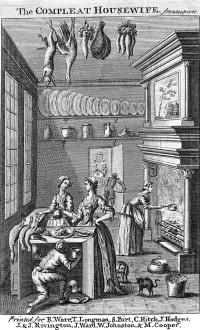
The left-hand page lists purchases of green slippers, rose lozenges, ribbon and muslin. The Housekeeper’s Receipt-Book, Or, the Repository of Domestic Knowledge; Containing A Complete System Of House-Keeping, formed upon the Principles of Experience And Economy . . .To Which Is Added, A Collection Of Marketing Tables, a System Of Domestic Book-Keeping, &c. &c. (1815). London: Printed By The Editor; And Sold by all Periodical Publishers in Town and Country. Printed By J. Haddon, Tabernacle Walk. This household manual contains a template for the instruction in keeping household accounts. The medieval tradition was for the staff to be seen as members of the family. Throughout the seventeenth and eighteenth centuries this attitude persisted. The mistress of a house was expected to know the names of all her servants and be concerned about their welfare, while delegating their daily management to the senior staff. The library’s collections also contain examples of instruction books for servants, as well as on the education of daughters: The Duties of a lady’s maid; with directions for conduct, and numerous receipts for the toilette. (1825). 1st edn. London: Printed For James Bulcock, 163, Strand. On p.44 in the section headed ‘Familiarity with Superiors’ there is a warning to a lady’s maid that they are ‘apt to be put off [their] guard’ because an employer is likely to be more familiar with a senior servant than they can ever be in return. Halifax, G.S. (1688) The Lady’s New Year’s gift: or, advice to a daughter, under these following heads: viz. religion, husband, house and family. Servants, behaviour and conversation, friendships, censure, vanity and affectation, pride. Diversions, dancing. The second edition, corrected by the original. 2nd edn. London: Printed for Matt. Gillyflower in Westminster-Hall, and James Partridge at Charing-Cross. In the section on ‘House, Family, &c.’ Halifax advises on p. 70 that ‘the respects even of the Children and Servants will not stay with one that doth not think them worth their Care’. The impulse towards privacy throughout the eighteenth century meant that the family and the servants lived and worked in increasingly separate spheres within the house. Chawton House’s changing layout demonstrates this with the construction of aisled halls, back stairs, and eventually a separate kitchen wing. In the nineteenth century at Chawton House the Staircase Hall – part of the family’s sphere – was separated from the Servants’ Passageway by a green baize door constructed in the arch between the passageway and the Staircase Hall. The Servants’ Passageway led to the kitchen, around which was built the North Wing, accommodating the servants and concluding the process of separating the household into ‘above stairs’ and ‘below stairs’: Smith, E. (1753) The Compleat housewife: or, accomplish’d gentlewoman’s companion. Being a collection of upwards of six hundred of the most approved receipts in cookery, pastry, confectionary, preserving, pickles, cakes, creams, jellies, made wines, cordials. With copper plates curiously engraven for the regular disposition or placing the various dishes and courses. As also bills of fare for every month in the year. To which is added, a collection of above two hundred family receipts of medicines; viz. drinks, syrups, salves, ointments, and various other things of sovereign and approved efficacy in most distempers, pains, aches, wounds, sores, & never before made publick; fit either for private families, or such publick-spirited gentlewomen as would be beneficient to their poor neighbours . 15th edn. London: Printed for R. Ware, S. Birt, T. Longman, C. Hitch, J. Hodges, J. and J. Rivington, J. Ward, J. Johnston, and M. Cooper. The frontispiece reproduced at the top of this blog entry illustrates a kitchen remarkably like the one of Chawton House Library with large windows providing good light for food preparation opposite the hearth where the food is being cooked. This book is available as a reprint from the library, and can be ordered in our shop. Profits from sales will help fund new acquisitions for the library collections.