
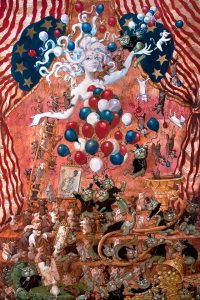
 ‘Keep a Woman on English Banknotes’ campaigner to support Hampshire event that explores the history and role of money in our lives.
Caroline Criado-Perez, who successfully fought to keep a woman on a Bank of England note, is to visit Hampshire to give a public lecture at Chawton House Library, a leading study centre for early English women’s writing.
The feminist activist will talk about the role of women and money in contemporary political culture.
The lecture is part of a two-day event, The Image of Finance: Why Jane Austen on the £10 Note Matters, which celebrates the Bank of England’s decision to depict Jane Austen on the £10 note.
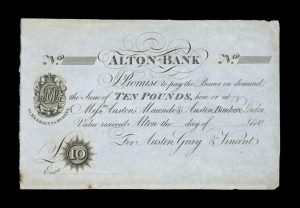 The event has been organised in partnership with the University of Southampton, the Leverhulme Trust and the Arts and Humanities Research Council and coincides with the arrival in Hampshire of the national touring exhibition Show Me the Money: The Image of Finance, 1700 to the Present.
The two-day event at Chawton House Library runs from Friday 19 to Saturday 20 September and delegates can choose to attend one or both days, or the free lecture alone on the Friday evening.
The Show Me the Money exhibition is the first in-depth exploration of the visual culture of the financial world from historical illustrations, prints, cartoons and games to contemporary painting, photography, video and installation. Touring to Sunderland, Hampshire and Manchester, the exhibition tells a particular financial story in each region.
In Hampshire, the exhibition will be shown simultaneously at Chawton House Library and at Southampton’s John Hansard Gallery, one of Britain’s leading galleries of contemporary art. At Chawton House Library, the emphasis will be on the critical but often overlooked role that women have played in telling the story of contemporary finance.
On display will be work by leading female artists, such as Jane Lawson, Rhiannon Williams, Geraldine Juárez, Justine Smith and Victoria Bradbury, who are concerned with exploring the material quality of money and finance, and the tension between money’s essential place in our lives and its fragile and transitory nature.
This includes William’s My Loss is My Loss, a paper quilt made from a decade’s worth of lottery tickets to Juárez’s Hello Bitcoin, a video installation of the artist burning a bitcoin, to Smith’s A Bigger Bang, a piece that represents deregulated finance through a cut-up map of money.
The two-day programme for The Image of Finance: Why Jane Austen on the £10 Note Matters features:
- Fri 19 Sep – Day Workshop: Money, Sovereignty and Representation (10am-5pm)
Cultural historians and theorists will join curators from the British Museum and British Library to discuss and debate the material forms of money, and ask: What does money really stand for?
Ticket price: £30 (£20 for students and unwaged delegates)
- Fri 19 Sep – Evening Lecture and Private View: Show me the Money: The Image of Finance at Chawton House Library (6pm – 8pm)
(Exhibition runs from 19 September to 22 November at Chawton House Library and the John Hansard Gallery in Southampton)
To support the private exhibition preview of Show me the Money, a public lecture will be given by Caroline Criado-Perez, feminist activist and spokesperson for the successful and controversial Keep a Woman on English Banknotes campaign.
Ticket price: free (booking required)
- Sat 20 Sep – University of Southampton Lifelong Learning Study Day: Banking in the Age of Jane Austen (9.30am to 5pm)
Speakers will address the rise of paper money and financial malpractice, the transformation of the social landscape by modern capitalism, and Austen’s own insider knowledge of the changing world of banking through her banker brother, Henry.
Ticket price: £40 (£30 for students and unwaged delegates
A two-day ticket costs £60 or £40 for students and unwaged delegates.
Keith Arscott, Development Director of Chawton House Library, said: “Women’s writing – and their creativity and inspiration – of the period 1600 to 1830 is at the heart of our unique library collection.
“So, to be hosting such an exciting range of events that not only celebrate Jane Austen’s appearance on the £10 note but give much needed recognition to the role that women have played in telling the story of contemporary finance, is doubly exciting for us and reinforces everything we stand for at Chawton House Library,” he added.
Professor Nicky Marsh of the University of Southampton said: ‘Chawton House Library is an important location for the exhibition because it allows us to draw the connections between the eighteenth century origins of our current financial system, as depicted by artists such as William Hogarth and James Gillray, and the crises of the contemporary financial world.”
She added: “Chawton House Library is also the perfect venue in which to highlight the specific role that women artists and writers have played in constructing this history; for exploring the ways in which the very languages of money and the market are influenced and shaped by questions of gender.”
Chawton House Library aims to educate and inspire people of all ages to read the works of early English women writers from 1600 to 1830, from Aphra Behn to Mary Wollstonecraft, and preserve the literary heritage for academics and non-scholars for generations to come.
The house itself, which is more than 400 years old, is regularly open to visitors, alongside library readers, for tours and during public events. It also provides research facilities for Visiting Fellows from around the world, learning projects with local schools and colleges and fosters links internationally through seminars and conferences.
For ticket sales, or to reserve a free place at the public lecture, visit Eventbrite or call Chawton House Library on 01420 541010.