
 Dr Amy Wilcockson is an MHRA Research Fellow at QMUL working on ‘The Letters of Percy Bysshe Shelley’. Prior to this, she was a Research Assistant at the University of Glasgow on the Leverhulme Trust-funded project ‘The Works of Robert Fergusson: Reconstructing Textual and Cultural Legacies’. She is the Communications Officer for the British Association for Romantic Studies. Based on her PhD thesis, Amy’s edition of The Selected Letters of Thomas Campbell (1777-1844) is forthcoming with Liverpool University Press. In November 2025, she undertook a Visiting Fellowship at Chawton House, and has written the following blog post about her research:
Fame, Fans and Funds: The Romantic-Period Subscription List
During the eighteenth and nineteenth centuries, a new publishing model became popular for aspiring authors. Instead of persuading a publisher to pay for the production costs of a book or selling them the copyright to their work, an author could publish by subscription. This was essentially an early type of crowdfunding, where authors could solicit friends, acquaintances, and those interested in their work to promise to pay for copies of their book. With this promise of advance payment, publishers would be increasingly likely to publish the book.
As critics such as Judith Pascoe and Thora Brylowe have argued, subscription lists also let authors build up a visible audience. This was especially important as the more prestigious the names on a subscription list, the more likely a book was to attract affluent patrons and sell more copies. Although subscription publishing never made up more than a small percentage (approximately 5%) of total publications, it was nevertheless an important mode of publishing, particularly for women and for new authors. For authors making their debut, subscription publishing became a popular way of ensuring their work was actually published. Notable patrons who bought numerous copies of a work, or a lengthy list demonstrated to publishers too that the market was there for a book.
In a letter to Anna Seward in 1802, Walter Scott remarked that: ‘The mode of publishing by subscription is one which in itself can carry nothing degrading & which in many of the more extensive & high priced publications is perhaps essentially necessary. Still however it is asking the public to become bound to pay for what they have not seen, & carries with it if not the reality at least the appearance of personal solicitation & personal obligation’ (1932-37, I, 163). As Scott notes, subscription publishing often had the reputation during the Romantic period of being potentially demeaning, as authors had to request funds from patrons and contemporaries which consequently put them in their subscribers’ thrall.
During my Fellowship in November 2025, I undertook a research project to examine subscription lists in the library’s extensive collections. I was particularly interested in subscription lists in female-authored books dating from 1730-1830, as this mode became increasingly associated with women wishing to publish during this time. Subscription lists were used particularly for those women who had fallen on hard times and were publishing by subscription to also raise funds for their own livelihood.
A sample of thirty of Chawton House’s rare books, all of which contained subscription lists, was analysed for a number of different characteristics.
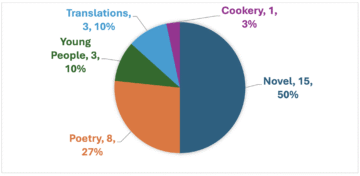 Fig 1. Genre of Chawton House sample books
Firstly, the books were surveyed via genre. 50% of the books were novels, 27% were books of poetry, 10% were aimed at young people, 10% were translations and 3% were cookery books. Poetry books were traditionally those most often published by subscription, but the Chawton sample also demonstrates a high number of novels which were also published in this way.
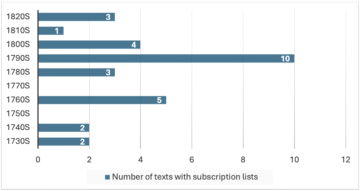
Fig 2. Number of Chawton House sample books published each decade 1730-1830.
Chawton’s collections also confirm that the 1790s were a key decade of publishing by subscription, with a third of the books examined being published during these ten years. The 1760s and 1800s were also popular decades for subscription volumes.
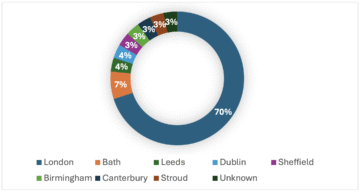
Fig 3. Place of publication using Chawton House sample books
Similarly, 70% of the books examined were unsurprisingly published in London, although Sheffield, Bath, Leeds, Dublin, Sheffield, Birmingham, Canterbury and Stroud also had active publishing centres, where subscription publishing thrived.
Studies of particular books also brought to light some interesting anomalies. In the case of Priscilla Haslehurst’s The Family Friend, or housekeeper’s instructor (1802), the subscription list was located at the back of the book, rather than the front as is usual. Perhaps this is because this book features the names of ordinary working people – many of whom are women – as the subscribers of this volume. Unlike other authors, Haslehurst perhaps did not need or aim for noble patrons with her cookery book, but at ordinary cooks. Her book had less need then of a prominent subscription list.
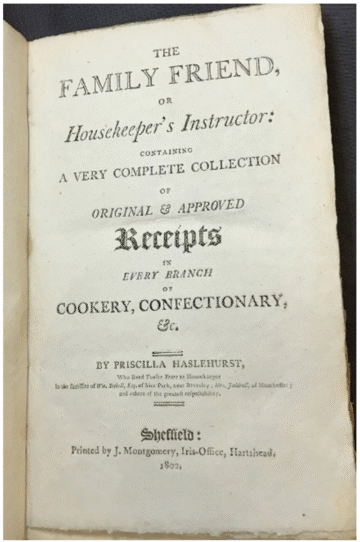
Fig 4. Priscilla Haslehurst, The Family Friend, or housekeeper’s instructor: containing a very complete collection of original & approved receipts in every branch of cookery, confectionary, &c. (Hartshead: J. Montgomery, 1802)
CHAWTON HOUSE. ACC. No. 342
Perhaps the most famous Romantic-period subscription list is that of Frances Burney’s Camilla: or, a picture of youth. After all, it is this subscription list which marks the first time Jane Austen ever saw her name in print. After subscribing her one guinea (around £100 in today’s money), Austen would have received her copy of the novel a year later (as this was the length of time it took for the novel to be written). And there her name proudly sits on the subscription list: ‘Miss J. Austen, Steventon’.
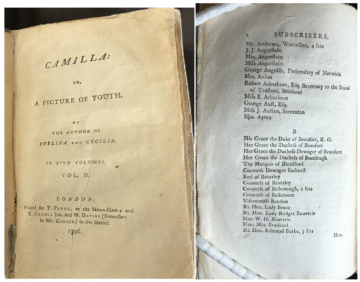
Figs 5 and 6. Frances Burney, Camilla: or, a picture of youth. In five volumes
(London: T. Payne, 1796)
CHAWTON HOUSE. ACC No. 141
During Austen’s own lifetime, her novels were published anonymously, attributed simply as ‘By A Lady’ on the title page. It wasn’t until 1817 with the posthumous publication of Northanger Abbey and Persuasion that Austen was revealed to be the author of these and her other works.
Overall, the Romantic-period subscription list can tell scholars much about publishing practices of the eighteenth- and nineteenth-centuries. By focusing on particular case studies, interesting information can be uncovered such as the histories of particular subscribers (like Jane Austen!). The lists also clearly map out networks of influence in this period – signalling who was sponsoring who, which authors attracted noble patrons, and which genres, decades and places of publication were popular.
*
You will be able to see more of Amy’s work later in the year in a Long Gallery display featuring some of the subscription list collections and novels that she was working on.