
An exhibition based on Dr. Laura Engel’s fascinating insight into eighteenth-century culture illustrated by the collections at Chawton House Library.
 Austen is famously associated with Elizabeth Inchbald because of the ill-fated production of Lovers’ Vows (1798) in Mansfield Park (1814). Inchbald adapted August von Kotzebue’s Das Kind der Liebe (1780); “Child of Love”, or “Natural Son”, as it is often translated. Inchbald’s version is one of four contemporary English dramatisations, and the only one to have been performed. Its subject is sex outside marriage, considered very risque material for the young women in Mansfield Park, and illegitimate birth. Inchbald declares in the Preface to the published version that she was highly sensitive to the task of adapting the original German text for “an English audience”. Chawton House Library’s copy of Lovers’ Vows is bound in one of the volumes of the following collection of plays:
The London Stage; A Collection Of The Most Reputed Tragedies, Comedies, Operas, Melo-Dramas, Farces, And Interludes. Accurately Printed From Acting Copies, As Performed At the Theatres Royal. (1826). London: Published For The Proprietors, By Sherwood, Jones, And Co. Paternoster-Row; And Sold By All Booksellers.
Elizabeth Inchbald (1753-1821) features in the exhibition catalogue, Perry, G., Roach, J. and West, S. (2011) The first actresses: Nell Gwyn to Sarah Siddons. London: National Portrait Gallery, with a brief account of her life and career. Mary Robinson, whose portrait by John Hoppner hangs in the Great Hall at Chawton House Library, is also included. She is also one of the subjects in the following book:
Engel, L. (2011) Fashioning celebrity: eighteenth-century British actresses and strategies for image making. Columbus: Ohio State University Press.
In Fashioning Celebrity (2011) Laura Engel suggests that eighteenth-century practices of self-promotion mirror contemporary ideas: marketing, framing and selling the elusive self. The lives and work of Sarah Siddons, Mary Robinson, Mary Wells and Fanny Kemble are explored, along with the portraits and cartoons that idealised and satirised them.
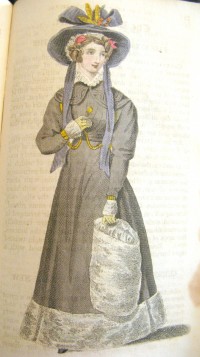
On p. 68 the portrait of Robinson by George Romney (1781), portrays her in a muslin cap and with a fur muff: she is presented as ‘a woman of sufficient means – domestic yet fashionable’ and far from the image of the whore she was satirised as in contemporary cartoons. Muffs featured in the fashion plates of women’s magazines:
The ladies’ pocket magazine. (1826). London: J. Robins & Co., Ivy Lane, Paternoster Row.
On pp. 212-3, is a fashion plate of a carriage dress accessorised with just such a sensible fur muff as Robinson has in her portrait (this is also the illustration for this blog entry).
La belle assemblee or, Bell’s court and fashionable magazine, addressed particularly to the ladies. Vol. XII.-New series. From January 1, to June 30, 1816. (1816). London: Printed for J. Bell, Gallery of Fine Arts, Clare-Court, Drury-Lane.
One of the plates features a Saxe-Coburg robe for evening full dress accessorised with ‘a muff formed of white satin and gossamer silk trimming’ – a statement muff rather than a practical one.
One perennially useful reference book:
Byrde, P. (1999) Jane Austen fashion: fashion and needlework in the works of Jane Austen. Ludlow: Excellent Press.
Byrde explains that large muffs for keeping hands warm were fashionable during the early years of the nineteenth century, as the plate on p. 41 shows. Austen’s novels Sense and Sensibility and Northanger Abbey both contain references to muffs and reveals Austen’s awareness of fashion:
Austen, J. (1813) Sense and sensibility: a novel. In three volumes / by the author of “Pride and prejudice.” . 2nd edn. London: Printed for the author, by C. Roworth, Bell-yard, Temple-bar, and published by T. Egerton, Whitehall.
Open at vol. 3, p. 72. Marianne in London, hoping for a change in the weather to deter further field sports, and as an increased chance of seeing Willoughby, remarks to Elinor: ‘I can hardly keep my hands warm even in my muff. It was not so yesterday, I think. The clouds seem parting too, the sun will be out in a moment…’
Austen, J. (1818) Northanger Abbey: and Persuasion / by the author of “Pride and prejudice”, “Mansfield Park” &c. With an autobiographical notice of the author. In four volumes. London: John Murray, Albermarle-Street.
Open at vol. 1, p. 101, while in Bath, savouring all its frivolous delights, James Morland is asked by Mrs Allen ‘to guess the price and weigh the merits of a new muff and tippett’. Northanger Abbey abounds with such references to material consumption with discussions of muslins and millinery.
One of the many books discussed throughout Austen’s satire on young women’s reading habits in Northanger Abbey is Samuel Richardson’s The History of Sir Charles Grandison (1753). It was a very popular book, despite being published in seven volumes and costing £20. Austen helped her niece, Anna, put together a play derived from the novel. Austen was Anna’s scribe for what was both an entertaining, and educational activity, and possibly a private theatrical like Lovers’ Vows in Mansfield Park.
Chawton House Library holds this manuscript but because of its fragility a facsimile is often displayed:
Austen, J. and Cecil, D. (ed.) (1981) Sir Charles Grandison or the happy man: a comedy in five acts; the original transcript in facsimile. Burford: David Astor of Jubilee Books.
Open at the title page of the facsimile. The manuscript will be discussed in detail in a forthcoming publication on Austen’s manuscripts by Kathryn Sutherland, Professor of Bibliography and Textual Criticism, St. Anne’s College, Oxford, who has recently worked on it as a Visiting Fellow at Chawton House Library.
The Austen family regularly held their own private theatricals at their home in Steventon, where they were often joined by other members of the family, including their cousin, Eliza de Feuillide (1761-1813). Eliza was charming and vivacious; she may have inspired some of Austen’s characters, such as Lady Susan, but also Mary Crawford in Mansfield Park. A fashionable woman, like Mary Crawford, she learned to ride and play the harp; according to another of the Austens’ cousins she was ‘rakish’. Born Eliza Hancock, she was raised in India, and married the Comte de Feuillide in 1781. Austen’s brother Henry became her second husband in 1797. An air of notoriety clung to Eliza because of the suspicion that she was the natural daughter of Warren Hastings, the first Governor-General of India – adding to the perception of rakishness surrounding her:
Austen-Leigh, R.A. (ed.) (1942) Austen Papers 1704-1856. London?: Printed by Spottiswoodie, Ballantyne & Co. Ltd.
Open at p. 151: ‘…the death of the Comte de Feuillide had occurred, viz. on February 22, 1794…. Henry Austen’s letter of April 26, 1795, refers to the acquittal of Warren Hastings, which had taken place on April 23.’
Warren Hastings had been accused of corruption in office, further adding to the scandalous aura around Eliza. Jane Austen had a close relationship with Eliza, and among their common interests they shared a love of the theatre and perhaps, we can speculate, of fashion too.
Details of the Library’s holdings can be found by accessing the online catalogue, along with information about Visiting Fellowships, on the website www.chawtonhouse.org.
Jacqui Grainger, Librarian