
 Economists are in trouble. They failed to predict the 2008 Financial Crash. In the aftermath of the crisis, they stand accused not only of failing to explain it, but of failing in their duty to educate the public about the workings and the risks of modern capitalism. They have an image problem. Who do they turn to? Jane Austen.
Thomas Piketty’s blockbuster Capital in the Twenty-First Century (2014) has taken the chattering classes by storm in the past few months. It has been hailed as a breakthrough demonstration of factors leading to the rise of economic inequality, and denounced as a botched speculation. But one remarkable feature of the book which has been little noticed in reviews is the presence there of Jane Austen. This is frankly astonishing. It is not just a matter of literary fiction being marshalled to illustrate an economic argument or bring to life a dry historical statistic. It is the fact that a French academic economist even knows about Austen, and is familiar enough with two of her novels to discuss them in some detail. Balzac, also frequently cited, one can understand. But Austen’s name had no currency in France until the spate of Hollywood adaptations over the past fifteen years or so.
For Piketty, Austen and Balzac alike provide an insight into the ‘deep structure of inequality,’ the ‘hidden contours of wealth’ (p. 2). For all the noise about free trade, dynamic capital, and meritocracy in the nineteenth century, the real story was about the persistent and growing importance of inherited wealth in determining life-chances. In Sense and Sensibility, Austen shows with absolute clarity that a return on land or bonds equivalent to 60 to 100 times the average income is needed in order to live in style. And Piketty urges that this picture can help us spot the lurking influence of the old-fashioned rentier today, even amid the glamorous jostling of multi-national corporations. The disappropriated Dashwood women, left with ‘barely four times the average per capita income’, stand for the vast majority condemned to live ‘mediocre and humiliating lives’ without the graces of, say, new books or musical instruments (p. 413, 414). There are repeated allusions to the notorious conversation between their half-brother John and his grasping wife Fanny, which will seal his sisters’ fate. Piketty seems to be haunted by it.
Austen is able to identify the truth behind the illusions, with the added benefit that she ‘speaks human’. The latter seems to have been the driver behind the title of another unexpected tribute: Jane Austen, Game Theorist (2013). The author, Michael Suk-Young Chwe, a professor of political science, is worried that the public have the wrong idea about game theory, which has been condemned, along with rational choice theory, as the basis for rampant free market individualism, red in tooth and claw. This cannot be so, Chwe maintains, because the novels show that Austen was a game theorist before the term was invented, and because the best players in her fiction are underdogs, women of slender means who must strategise in order to find happiness in a patriarchal world. There is something appealing about Chwe’s interpretation of the novels, with its tenacious focus on motives and payoffs, but can there be smoke without fire? Is Austen being used in a cover-up for the regrouping forces of militant neo-liberalism?
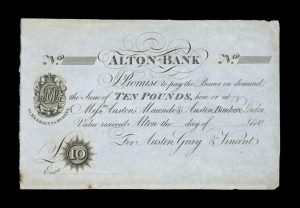
Watch this space. And in the meantime, come to the study day Banking in the Age of Jane Austen at Chawton House Library on Saturday 20 September, where you can find out more about the economic world Austen lived in, her brother Henry’s banking business, and what we can gather about her attitude to finance from the letters and novels.
References
Capital in the Twenty-First Century by Thomas Piketty, translated by Arthur Goldhammer, Harvard University Press, 2014.
Jane Austen, Game Theorist by Michael Suk-Young Chwe, Princeton University Press, 2013.
How to book for Banking in the Age of Jane Austen
Buy tickets online at Eventbrite or ring Chawton House Library direct on 01420 541010.